.gif)

My Selene
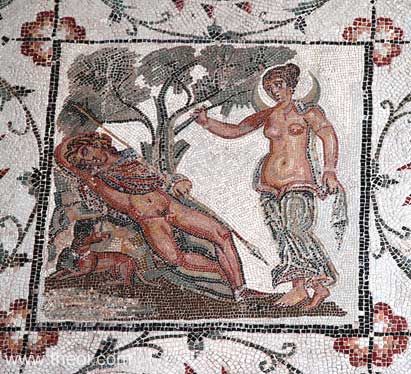
Yesterday (31st of March) would have been Luna's festival in Ancient Rome (also known as Selene in ancient Greece).
She's my beloved goddess despite me not being her true Endymion.
Selene was the daughter of Hyperion and Theia (in most versions):
Hesiod, Theogony 371 ff (trans. Evelyn-White) (Greek epic C8th or C7th B.C.) :
"And Theia was subject in love to Hyperion and bare great Helios (Sun) and clear Selene (Moon) and Eos (Dawn) who shines upon all that are on earth and upon the deathless Gods who live in the wide heaven."
She had many children: the Menai (the 50 months of the 4 Olympic years), Ersa (Dew), Pandia (all-gifts) and, accordingly, the four Horai (Seasons).
According to certain sources she nurtured the terrible Nemeian Lion:
Aelian, On Animals 12. 7 (trans. Scholfield) (Greek natural history C2nd A.D.) :
"They say that the Lion of Nemea fell from the moon (selene). At any rate Epimenides [C6th B.C. poet] also has these words : `For I am sprung from fair-tressed Selene the Moon, who in a fearful shudder shook off the savage lion in Nemea, and brought him forth at the bidding of Queen Hera.'"
Yet her most famous feat was to fall in love with the mortal Endymion:
Quintus Smyrnaeus, Fall of Troy 10. 127 ff (trans. Way) (Greek epic C4th A.D.) :
"That haunted cave [on Mt Latmos] of fair-haired Nymphai where, as Endymion slept beside his kine, divine Selene watched him from on high, and slid from heaven to earth; for passionate love drew down the immortal stainless queen of night. And a memorial of her couch abides still 'neath the oaks; for mid the copses round was poured out milk of kine; and still do men marvelling behold its whiteness. Thou wouldst say far off that this was milk indeed, which is a well-spring of white water : if thou draw a little nigher, lo, the stream is fringed as though with ice, for white stone rims it round."
Selene was worshipped at Thalamai (Lakedaimonia), Elis and on the Aventine Hill in Rome as Luna.
Finally, the Homeric Hymn to Selene:
(ll. 1-13) And next, sweet voiced Muses, daughters of Zeus, well- skilled in song, tell of the long-winged Moon. From her immortal head a radiance is shown from heaven and embraces earth; and great is the beauty that ariseth from her shining light. The air, unlit before, glows with the light of her golden crown, and her rays beam clear, whensoever bright Selene having bathed her lovely body in the waters of Ocean, and donned her far-gleaming, shining team, drives on her long-maned horses at full speed, at eventime in the mid-month: then her great orbit is full and then her beams shine brightest as she increases. So she is a sure token and a sign to mortal men.
(ll. 14-16) Once the Son of Cronos was joined with her in love; and she conceived and bare a daughter Pandia, exceeding lovely amongst the deathless gods.
(ll. 17-20) Hail, white-armed goddess, bright Selene, mild, bright-tressed queen! And now I will leave you and sing the glories of men half-divine, whose deeds minstrels, the servants of the Muses, celebrate with lovely lips.
The Second Part of the Ostara article will be up relatively soon, followed by articles on Thessalian Witchcraft and The Christian Roots of our Ecological Crisis. STAY TUNED!


 Posts
Posts

